Critical, the minute it is written
By email, Slack or webhook. A checkout that broke at three in the afternoon does not wait for breakfast.
Everything happening in your SaaS, without opening every tool. Vesqo is a business observability tool for SaaS companies: it reads Stripe, PostHog, GitHub, Sentry, support and CRM together and writes up what changed, which paying customers it hit, and what it costs. When they disagree with last week, it writes the page: the release, the customers, the euros, the next step.
For founders and small teams running a SaaS, with the tools and not the data team. The demo is a real workspace with a bad release in it; trials need no card; every connection is read-only.
v2.14.0 shipped to production.
Errors at 43 an hour, against 4 an hour last week.
×10.515 checkouts completed since the release, where the same window last week saw 52.
−71%2 payments failed, Acme Labs and Cortex.
€7986 conversations opened, where that half hour usually sees none. Checkout shows no total, can't pay.
Possible checkout regression after v2.14.0
Hit Cortex (€499 a month), Acme Labs (€299) and Fjord (€99). Cortex and Acme Labs both tried to pay and could not: €798 a month at stake. Roll v2.14.0 back first, then write to them.
Sentry saw the errors. PostHog saw the checkouts. Crisp saw the chats. Stripe saw the failed payments. None of them saw the release, or each other. Vesqo read all four against the same hours last week, dated the change to v2.14.0, and named who it hit. The page it makes is one you can act from: ask about it, give someone the task, or mark it done.
Open the demo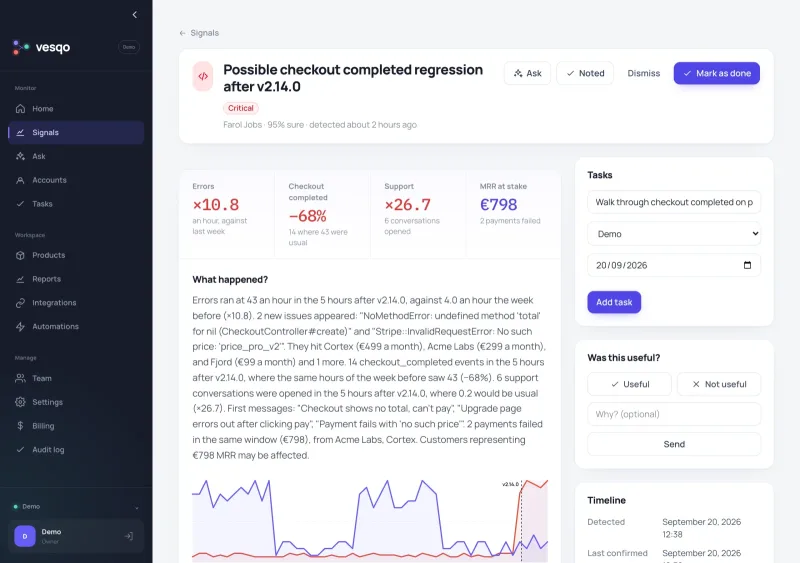
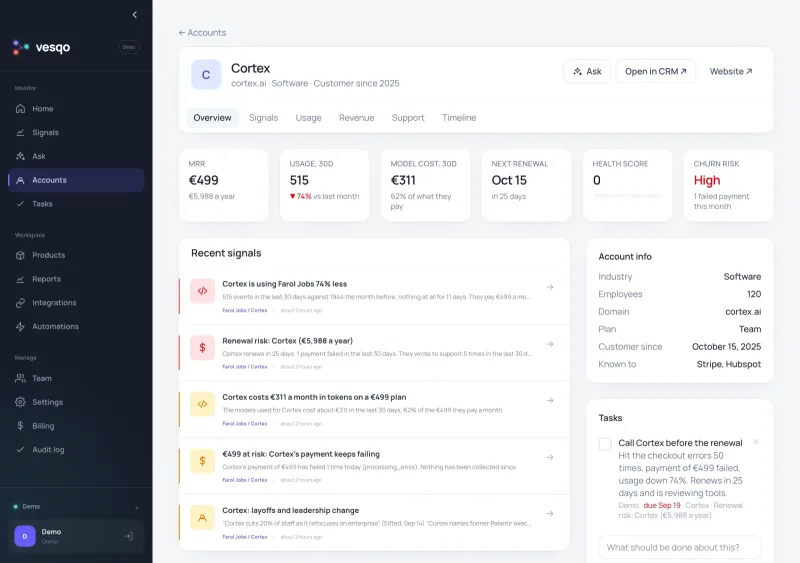
Before the renewal call: what Cortex pays, how much less they use you than last month, the payment that failed, what they wrote to support, the deal in HubSpot and the layoffs in the news. A churn risk you can argue with.
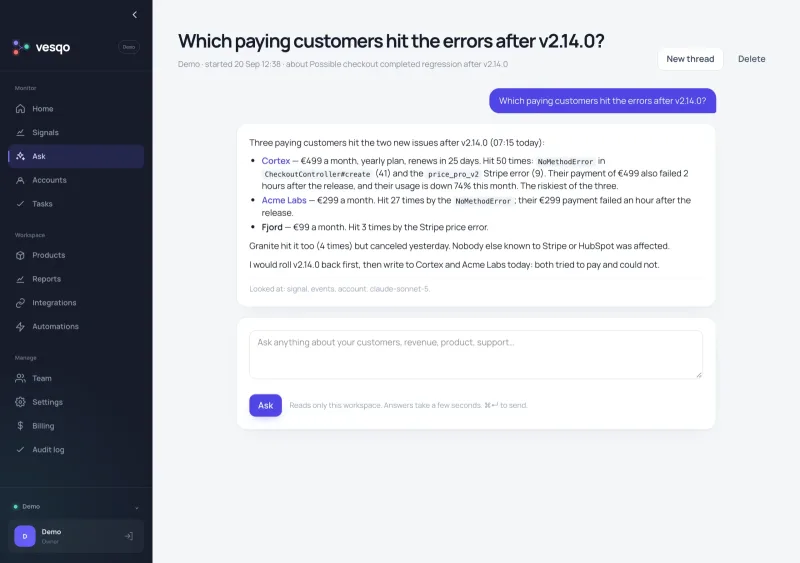
Which paying customers hit the errors after v2.14.0? Vesqo reads the same tools, answers with names and amounts, and says what it looked at. Every question and answer sits in the audit log.
Connect what you have: each connection is a key with read scope or an OAuth click, and the connect page says what it needs. Vesqo keeps a history of each source and reads them against each other, so a change in one is dated to a change in another.
 Stripe
 Paddle
 Lemon Squeezy
 WooCommerce
Subscriptions, invoices, payments, refused card attempts, the provider's fees.
Catches
MRR moving, a payment failing, a cancellation, a customer paying more or less than last month, stolen cards being tested against the checkout, Stripe's fees jumping.
 PostHog
 Mixpanel
 Plausible
 Google Analytics
Events, by account where the source has them.
Catches
A customer using you less, a funnel dropping, a feature nobody touches.
 GitHub
 GitLab
 Vercel
Releases, deploys, pull requests.
Catches
What shipped, and when, so a change elsewhere can be dated to it.
 Sentry
 Bugsnag
 Rollbar
 Honeybadger
 Datadog
 New Relic
 Prometheus
Issues and rates.
Catches
A regression, timed against the release and read with the checkouts.
 Crisp
 Intercom
 Help Scout
 Zendesk
Conversations.
Catches
Who is writing, about what, and whether they pay.
 HubSpot
 Attio
 Pipedrive
Deals and contacts.
Catches
A deal going quiet, an expansion closing, the champion leaving.
 AWS
 Hetzner
 Better Stack
 Checkly
 Pingdom
 UptimeRobot
 OpenAI
 Anthropic
Uptime, and what you spend.
Catches
Downtime a customer felt, a bill that doubled.
About the companies that pay you.
Catches
Layoffs, funding, an acquisition, a hiring spree at a customer.
When you want it to do something with what it found, an automation can open the issue in Linear, Jira or GitHub, post to Slack or Discord, or call a webhook. Nothing is written back to a source unless you set that up.
A critical signal reaches the team the minute it is written. Everything else goes into one email in the morning, and the rest of the day is quiet.
By email, Slack or webhook. A checkout that broke at three in the afternoon does not wait for breakfast.
What changed since yesterday, ranked, with the money next to each line. Across every product you run, so one morning covers the portfolio.
Renewal risk: Cortex renews in 25 days, one payment failed, five support threads.
Cortex is using Farol Jobs less: 514 events this month against 1,941 last.
Possible checkout regression after v2.14.0: errors ×10.5, checkouts −71%.
Deal at risk: the Acme Labs expansion closes in 30 days, and a payment failed this month.
API keys with read scope, or OAuth with the least it can ask for. Vesqo writes to a tool only through an automation you made.
The application and its database run at Hetzner in Falkenstein, Germany. Backups are encrypted and stay in the EU.
Questions go to the AI provider under its commercial terms: not used to train models, normally deleted within 30 days. Every question, answer, automation run and change of settings is logged, by whom, when.
Every source, every signal, the morning brief, Ask, automations and the API, whichever you pick. Plans differ only in size: products, integrations, seats and Ask questions a month. A product is one stack, a Stripe account, a repo, an error tracker and the rest, read together.
One product, its whole stack, a small team.
€29a month
A portfolio, every integration, the team.
€79a month
No limits, priority support.
€199a month
The trial is fourteen days of everything, without a card. Pick a plan at the end, or don't: a workspace without one is paused, and keeps its data for 90 days in case you come back; then it is deleted. What a product is, and what happens at each limit.
The demo is Farol Jobs, the afternoon above, every screen open. Ask it anything. Then connect your own.
Vesqo would like to count visits with Google Analytics and see which of its Microsoft ads lead to a sign-up. Their cookies are set only if you say yes, and the site is the same either way. Cookie notice